Why Meat Processing Facilities Should Automate Tote and Crate Washing
Reusable totes and crates are everywhere in meat processing.
They may carry raw materials, ingredients, work-in-process products, packaged items, or other materials from one part of the facility to another.
Because they are reused, those containers eventually need to be cleaned and returned to production.
As production volume grows, that can become a major sanitation task.
A small operation may be able to wash containers manually.
A high-volume meat-processing facility may be dealing with hundreds—or even thousands—of reusable containers during a production day.
At that point, washing totes and crates by hand can become a significant bottleneck.
Custom Wash Solutions provides automated tote and crate washing systems designed to improve sanitation consistency, reduce manual labor, and keep reusable containers moving through high-throughput environments. The company specifically serves protein/meat, beef, poultry, pork, and fish operations. Custom Wash Solutions
Why Tote and Crate Cleaning Matters
Reusable containers move through many different stages of a meat-processing operation.
Depending on the facility, totes or crates may come into contact with moisture, protein residue, fats, debris, packaging materials, or other production soils.
If containers are going to return to the production environment, the cleaning process needs to be dependable and repeatable.
The challenge is not simply washing one container.
It is doing the same job consistently hundreds of times.
That is where automation becomes valuable.
Manual Washing Can Become a Production Constraint
Manual tote and crate washing may require employees to handle each container individually.
That can involve rinsing, scrubbing, rotating, inspecting, stacking, and moving containers back into circulation.
As volumes increase, the amount of labor required increases too.
The sanitation team may suddenly be responsible for cleaning containers as quickly as production creates them.
If cleaning cannot keep up, dirty containers begin waiting.
Eventually, the plant may experience a shortage of clean totes or crates.
At that point, sanitation is no longer just a cleaning issue.
It has become a production issue.
Custom Wash Solutions describes its UN-Series as a solution for operations that need reliable, repeatable cleaning without the time and inconsistency associated with manual washing. Custom Wash Solutions
Automated Washing Improves Consistency
Manual cleaning depends on the employee performing the task.
One person may spend more time on each crate.
Another may use more water.
Another may focus more heavily on one area of the container.
Automated washing creates a defined process.
The container moves through the system, receives a controlled wash treatment, and then moves through the rinse process.
That helps create more repeatable results from one crate to the next.
In meat processing, where hundreds of reusable carriers may need to be cleaned every day, that consistency can become extremely valuable.
Faster Container Turnaround
Reusable containers are productive only when they are available.
A tote sitting in a wash area cannot be used in production.
That means cleaning speed directly affects how quickly carriers can return to service.
Custom Wash Solutions’ standard crate-washer configuration is rated for approximately 200 to 800 crates per hour, depending on contamination level and selected options. Custom Wash Solutions
For high-volume operations, that kind of capacity can dramatically change the sanitation workflow.
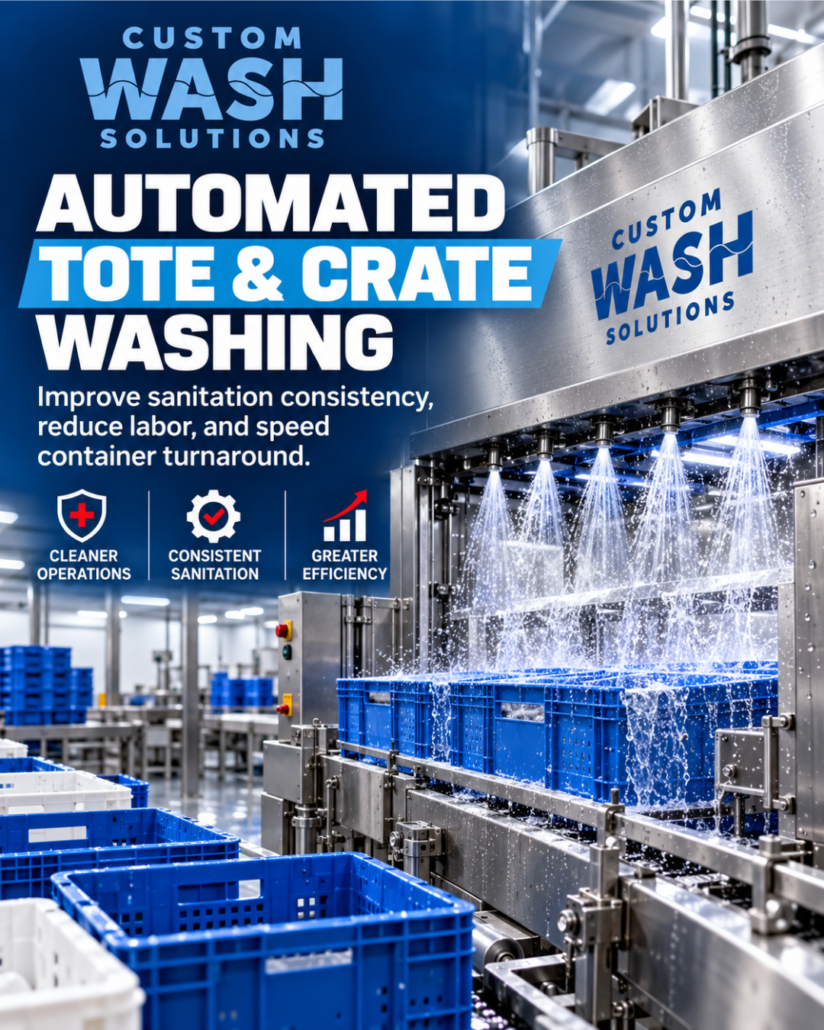
Instead of washing containers one at a time, the facility can create a continuous cleaning process.
Dirty containers enter one side.
Clean containers exit the other.
Reduce Manual Labor
One of the biggest benefits of automation is reducing the amount of repetitive work required from sanitation employees.
Rather than manually cleaning every container, employees can focus on loading, unloading, monitoring, inspection, and other sanitation responsibilities.
That can be particularly important when labor is limited or difficult to recruit.
Automating repetitive tote and crate washing does not eliminate the need for sanitation employees.
It allows those employees to spend less time performing the same manual wash task repeatedly.
More Controlled Water Use
Water use is a major consideration in food-processing sanitation.
Manual washing can involve open hoses, sinks, spray stations, and significant variation between employees.
Automated systems can control water flow more precisely.
The standard CWS crate washer lists adjustable water consumption of approximately 4–8 liters per minute. Custom Wash Solutions
That gives facilities more control over how water is used during the process.
Recirculation Helps Improve Efficiency
The CWS UN-Series uses a pivoting spray system while continuously filtering the wash water. The separate rinse zone uses clean water, and that rinse water can then be reused in the washing process. Custom Wash Solutions
That kind of design helps facilities use water more efficiently while maintaining a strong cleaning process.
Instead of treating every gallon of water as single-use, the system is designed around filtration and reuse.
For meat-processing facilities operating sanitation systems every day, those efficiencies can add up.
Strong Spray Coverage Matters
Reusable totes and crates can have complicated surfaces.
They may include corners, ribs, handles, edges, recessed areas, and other features where soil can collect.
The CWS UN-Series uses a pivoting spray system with clip nozzles designed to provide strong cleaning coverage. Custom Wash Solutions
The goal is to expose the container to a repeatable spray pattern rather than relying on an employee to manually reach every area.
Automation Can Help Eliminate a Sanitation Bottleneck
A production line can operate efficiently and still struggle because reusable containers are not returning fast enough.
Imagine a plant where production needs hundreds of clean totes each hour.
If the sanitation team can only clean a fraction of that number manually, containers become a constraint on production.
Automated washing can help synchronize sanitation capacity with production capacity.
That means the plant can plan around a predictable number of containers being cleaned each hour.
A More Scalable Process
Manual washing may work when the plant is small.
But what happens when production grows?
A facility may need more containers.
More sanitation employees.
More wash stations.
More water.
More floor space.
Automated washing provides another way to scale.
Instead of adding labor every time production increases, the facility can use an industrial washing system designed for higher throughput.
Designed for Industrial Food Processing
Equipment used in meat processing needs to withstand demanding sanitation environments.
The standard CWS crate washer uses stainless steel 304 construction, a stainless steel chain transport system, and a stainless steel pump. Custom Wash Solutions
The system is also described as compact, hygienically designed, customizable, easy to use, and intended for low maintenance costs. Custom Wash Solutions
Those characteristics matter when equipment is expected to operate repeatedly in a wet, industrial sanitation environment.
When Should a Meat Processor Consider Automated Tote and Crate Washing?
A facility may be ready to evaluate automation when the current wash process requires substantial labor, clean containers are not returning quickly enough, sanitation quality varies between employees or shifts, water use is difficult to control, production volume is increasing, or totes and crates are becoming a bottleneck.
The important question is not simply whether manual washing still works.
It is whether manual washing can continue supporting the production volume the facility needs.
Match Washing Capacity to Production Capacity
Reusable carriers are part of the production system.
If clean totes and crates are not available when production needs them, the rest of the facility can suffer.
That is why container sanitation should be planned with the same attention as processing equipment.
Manufacturers should understand how many containers are used, how quickly they become dirty, how quickly they need to return, and whether the wash process can keep pace.
A Better Way to Keep Reusable Containers Moving
Automated tote and crate washing can help meat processors turn sanitation from a labor-heavy batch process into a more consistent production-support system.
The potential benefits include faster container turnaround, more consistent cleaning, reduced manual labor, controlled water use, and a sanitation process that can scale with production.
Custom Wash Solutions offers automated tote and crate washers designed for reusable carriers in meat, beef, poultry, pork, fish, and other food-processing operations. Custom Wash Solutions
Learn more about Custom Wash Solutions Tote & Crate Washers or contact Custom Wash Solutions to discuss the number, type, and size of containers your facility needs to clean.