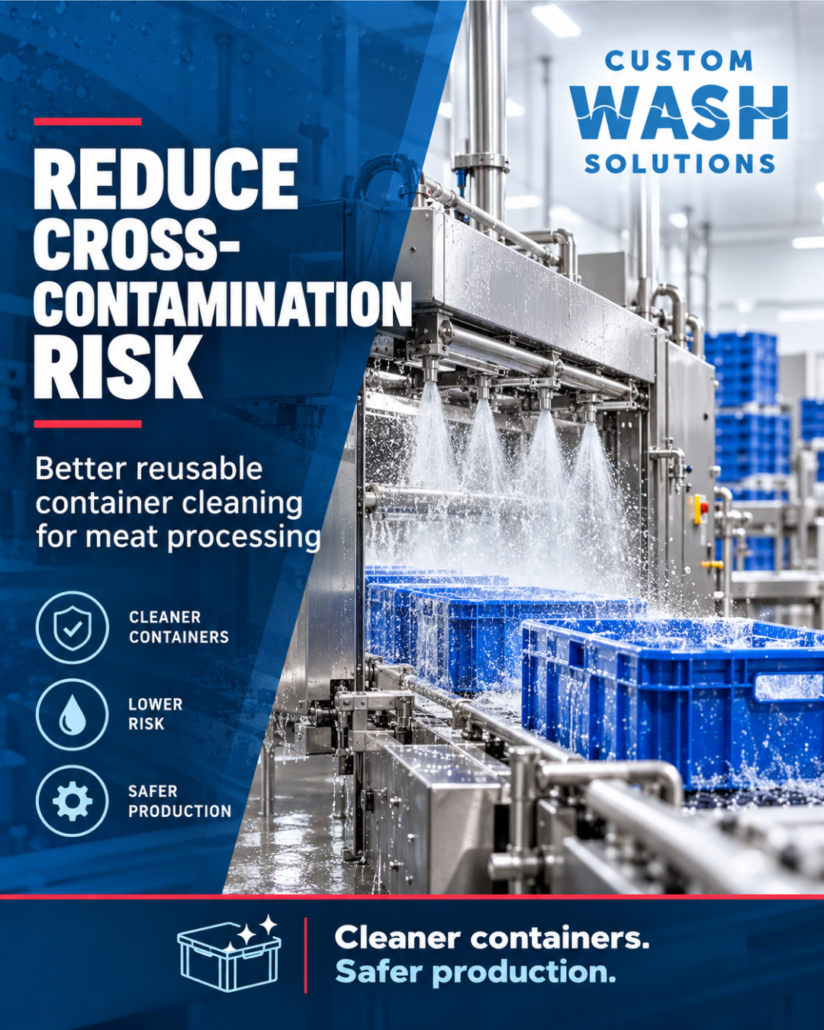
How to Reduce Cross-Contamination Risk With Better Reusable Container Cleaning
Reusable containers play an important role in meat processing.
Totes move ingredients and work-in-process product.
Crates carry materials between production areas.
Bins, carts, racks, and pallets support the movement of products throughout the facility.
Because these items are reused, they also need to be cleaned consistently before returning to service.
That makes reusable-container sanitation an important part of the larger food-safety process.
The challenge is not simply making containers look clean.
The challenge is creating a repeatable cleaning process that helps reduce the chance that residue, soil, or other contaminants move from one production area or product cycle to another.
Custom Wash Solutions designs industrial wash systems for reusable containers used in demanding food and protein-processing environments.
Why Reusable Containers Need a Controlled Cleaning Process
Reusable containers can move through many different areas of a processing plant.
Depending on the application, they may come into contact with:
- Raw product
- Fat
- Protein residue
- Moisture
- Packaging debris
- Floor splash
- Production soils
If those items return to production without consistent cleaning, they can create an unnecessary sanitation risk.
That is why reusable carriers should be treated as part of the sanitation system, not just as material-handling tools.
Cross-Contamination Risk Often Starts With Movement
Cross-contamination is fundamentally about unwanted transfer.
A container can move from:
- One production area to another
- Raw processing to downstream handling
- Storage back into production
- Sanitation back into active use
Every transition creates another opportunity for contamination to move with the equipment.
A consistent wash process helps interrupt that cycle.
1. Standardize the Cleaning Process
Manual cleaning can vary from one employee to another.
One operator may spend more time on corners.
Another may use more water.
Another may rinse more thoroughly.
Automated washing creates a more repeatable process.
That can help standardize:
- Wash exposure
- Spray coverage
- Rinse time
- Water flow
- Container handling
The more consistent the process, the easier it becomes to manage sanitation expectations.
2. Clean the Hard-to-Reach Areas
Reusable totes and crates often have:
- Handles
- Ribs
- Corners
- Recesses
- Drain openings
- Structural supports
These areas can be more difficult to clean manually.
Industrial wash systems are designed to provide spray coverage across the container rather than relying on hand-directed rinsing alone.
That can improve cleaning consistency across surfaces that are otherwise easy to miss.
3. Reduce Human Variation
Manual sanitation depends heavily on employee technique.
Even with good training, variability is natural.
Automated washing reduces some of that variation by using a controlled cycle.
That helps facilities create a more predictable cleaning standard from one shift to the next.
4. Keep Dirty and Clean Containers Moving Separately
Workflow matters.
A good sanitation process should reduce the chance that washed containers are exposed to dirty containers again.
Facilities should consider:
- Where dirty containers enter the wash area
- Where clean containers exit
- Whether clean and dirty traffic paths cross
- How containers are stored after washing
- How quickly they return to production
An automated wash system can help create a more organized flow from dirty to clean.
5. Improve Turnaround Time
If cleaning takes too long, dirty containers may accumulate.
That can create pressure to rush the process or return containers to production too quickly.
Faster, more predictable washing can help reduce that pressure.
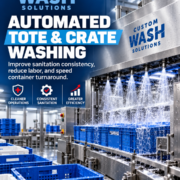
Custom Wash Solutions offers high-throughput systems designed for reusable totes, crates, bins, carts, racks, and pallets.
6. Use the Right Washer for the Right Container
Not every reusable item should be cleaned the same way.
A tote is different from a bulk bin.
A cart or rack has different geometry than a pallet.
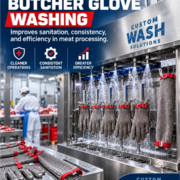
A chain mail glove has different sanitation needs than a crate.
Custom Wash Solutions offers separate systems for:
- Totes and crates
- Bulk bins
- Carts and racks
- Pallets
- Butcher gloves
Using equipment designed around the shape and size of the item can help improve cleaning effectiveness.
7. Reduce Manual Handling During Sanitation
Every additional manual handling step creates more variation and more opportunity for containers to contact surrounding surfaces.
Automation can reduce the number of times containers need to be:
- Picked up
- Rotated
- Repositioned
- Carried
- Set down
A more controlled path through the wash process can support a cleaner workflow.
8. Improve Water Management
Sanitation performance is not only about using more water.
It is about using water effectively.
Automated systems can control:
- Water flow
- Spray direction
- Wash time
- Rinse exposure
Custom Wash Solutions systems may also use filtration and water recirculation to improve efficiency.
That helps facilities balance sanitation performance with operational water use.
9. Reduce the Risk of Dirty Containers Returning to Production
A common sanitation problem is losing track of which containers have been cleaned.
A structured wash process helps create clear separation between:
- Dirty inventory
- Containers in process
- Clean inventory
That can help reduce the chance that a container bypasses the cleaning step.
10. Support More Consistent Sanitation Procedures
A repeatable industrial wash process can also support the broader sanitation program.
Facilities can define:
- Standard wash cycles
- Container flow
- Cleaning frequency
- Inspection procedures
- Return-to-service steps
That makes reusable-container sanitation easier to manage as part of standard operating procedures.
Which Reusable Items Should Meat Processors Evaluate?
Facilities should look closely at any reusable item that regularly moves through production.
That may include:
- Totes
- Crates
- Bulk bins
- Carts
- Racks
- Pallets
- Reusable trays
- Protective equipment
If the item repeatedly returns to service, the cleaning process matters.
When Is Manual Cleaning No Longer Enough?
Manual washing may become difficult to sustain when:
- Container volume is increasing
- Sanitation quality varies
- Employees spend too much time washing
- Dirty containers accumulate
- Water use is difficult to control
- Clean-container turnaround is slowing production
- The facility needs more repeatability
At that point, automated washing may provide a more consistent approach.
Better Container Cleaning Supports a Better Sanitation Program
Reusable equipment is part of the production environment.
That means it should be treated with the same attention as other sanitation-critical surfaces and processes.
A stronger container-cleaning program can help facilities:
- Improve consistency
- Reduce cross-contamination risk
- Reduce manual labor
- Improve turnaround
- Create clearer dirty-to-clean flow
The goal is not simply cleaner containers.
The goal is a more controlled sanitation process.
Custom Wash Solutions designs industrial wash systems for reusable items used throughout meat and protein processing.
If your team is relying heavily on manual cleaning for totes, crates, bins, carts, racks, or pallets, explore Custom Wash Solutions’ equipment to find a system that fits your application.