Pallet Washing for Meat and Poultry Processors: Why Clean Pallets Matter
Pallets are often treated as simple material-handling equipment.
But in meat and poultry processing, they move through some of the most sanitation-sensitive parts of the operation.
They may carry totes, cartons, bins, finished products, packaging materials, or ingredients between processing areas, coolers, warehouses, and shipping.
Because they are reused, they can also carry moisture, debris, residue, or other soils from one area to another if they are not cleaned consistently.
That makes pallet washing more than a housekeeping task.
It is part of the broader sanitation process.
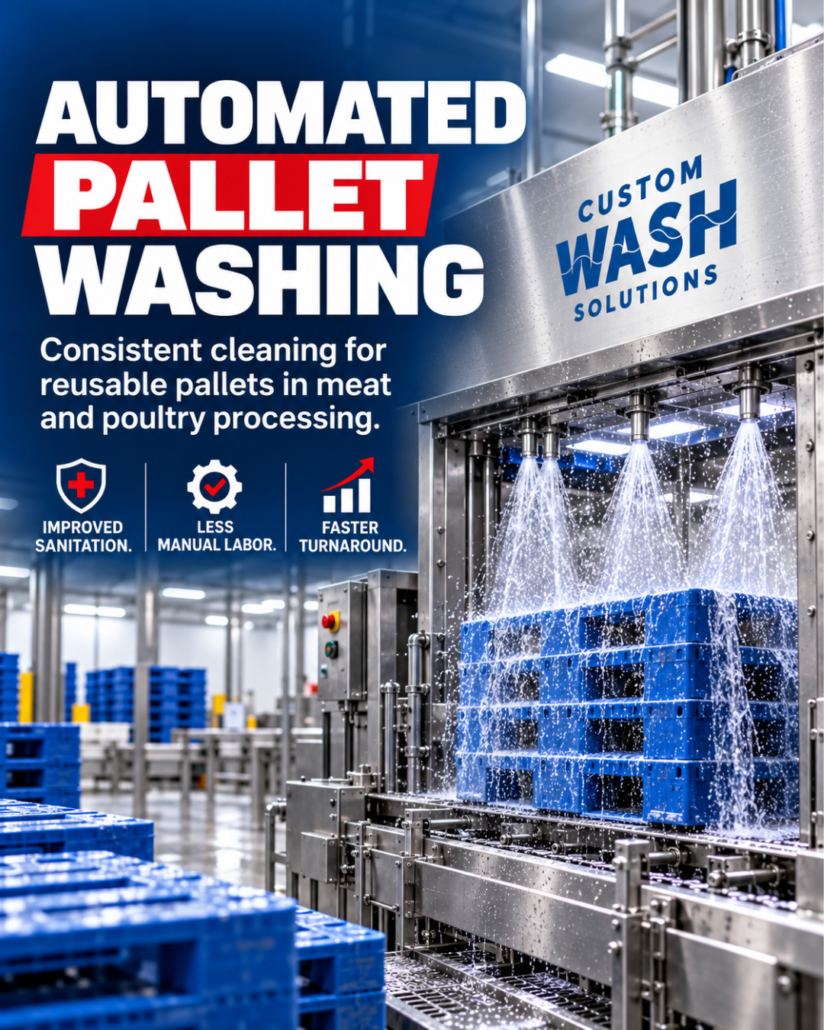
Custom Wash Solutions offers industrial pallet washing systems designed to help food and protein processors clean reusable pallets more consistently and efficiently.
Why Pallet Cleaning Matters in Protein Processing
Pallets may travel through:
- Production areas
- Cold storage
- Warehouses
- Shipping docks
- Receiving areas
- Packaging operations
As they move, they can come into contact with floors, equipment, forklifts, containers, and other surfaces.
That means reusable pallets can become part of the pathway through which soil or contaminants move around a facility.
A repeatable pallet-cleaning process helps reduce that risk.
1. Manual Pallet Washing Takes Time
Pallets are awkward to clean by hand.
Employees may need to:
- Flip them
- Rotate them
- Spray both sides
- Reach into openings
- Clean edges and supports
- Move them again after washing
That can consume significant sanitation labor.
The larger the pallet inventory, the harder that process becomes to maintain manually.
Automation can reduce the amount of repetitive handling required.
2. Automated Washing Improves Consistency
Manual cleaning varies by employee and shift.
One person may focus heavily on the top surface.
Another may spend more time on the underside.
Automated systems use a controlled wash process.
That can help create more consistent cleaning across:
- Top surfaces
- Bottom surfaces
- Edges
- Openings
- Structural supports
Repeatability becomes especially important when hundreds of pallets need to be washed regularly.
3. Cleaner Pallets Support Better Sanitation Flow
A pallet can move between different zones within the same facility.
If the cleaning process is inconsistent, the pallet can carry residue from one part of the plant into another.
A dedicated pallet-washing system can help create a clearer workflow:
Dirty pallets → Washing → Rinse → Clean staging → Return to service
That process helps facilities maintain better separation between dirty and clean pallet inventory.
4. Reduce Repetitive Labor
Pallet washing is physically repetitive.
Employees may spend hours lifting, turning, rinsing, and moving pallets.
Automated pallet washers can help reduce that workload and allow sanitation employees to focus on:
- Inspection
- Facility sanitation
- Equipment cleaning
- Monitoring
- Other higher-priority tasks
That can be especially valuable when sanitation teams are already stretched thin.
5. Improve Pallet Turnaround
A dirty pallet is not available for production.
If pallets sit waiting to be cleaned, a facility may eventually run short of clean inventory.
That can create a production problem.
Automated washing can help create a more predictable rate of pallet cleaning and return clean pallets to service faster.
6. Support High-Volume Operations
Manual cleaning may work at low volume.
But high-throughput meat and poultry processors may use large numbers of pallets every day.
As volume increases, the sanitation process must scale too.
Automation can help facilities avoid simply adding more labor or wash stations as production grows.
7. Better Water Control
Manual pallet washing can use large amounts of water, especially when hoses run continuously.
Automated systems can apply water in a more controlled and repeatable way.
Custom Wash Solutions pallet washers are designed around industrial wash applications and can use filtered wash water with a separate clean-water rinse.
That helps facilities use water more strategically while maintaining a controlled wash process.
8. Clean Pallets Can Help Protect Downstream Operations
Pallets often support products that are already processed, packaged, or ready for storage.
If the pallet itself is not clean, it can introduce an unnecessary sanitation concern into downstream areas.
Keeping pallets clean helps support the integrity of:
- Packaging
- Finished goods handling
- Cold storage
- Warehousing
- Shipping
9. Pallet Dividers May Need Cleaning Too
Some facilities use dividers or separator sheets between palletized products.
These reusable items may also need regular cleaning.
A washing system designed for pallets can sometimes be configured to support other flat reusable items as well.
That can help centralize more of the sanitation workload.
10. Stainless Steel Construction Matters
Equipment used in a meat or poultry processing environment needs to withstand frequent washing, moisture, and sanitation chemicals.
Industrial pallet washers are typically built with stainless steel and designed for repeated use in wet environments.
That helps support durability and long-term operation.
When Should a Processor Consider Automated Pallet Washing?
A facility may be ready to evaluate automation when:
- Employees spend significant time washing pallets
- Pallet cleaning is inconsistent
- Dirty pallets accumulate
- Clean pallets are not returning quickly enough
- Production volume is increasing
- Water use is difficult to control
- Sanitation labor is needed elsewhere
- Pallets move between multiple production zones
If several of these conditions exist, pallet washing may be a strong sanitation process to automate.
Questions to Ask Before Choosing a Pallet Washer
Before selecting a system, processors should consider:
- What pallet sizes are used?
- Are pallets plastic, metal, or another material?
- How many pallets need to be washed per hour?
- How heavily soiled are they?
- Are dividers or other flat items also being cleaned?
- How much floor space is available?
- How quickly must clean pallets return to service?
These answers help determine the right equipment configuration.
Pallet Washing Is Part of a Larger Sanitation Strategy
A clean production environment depends on more than cleaning the main processing equipment.
Reusable carriers matter too.
That includes:
- Totes
- Crates
- Bulk bins
- Carts
- Racks
- Pallets
When those items move throughout the facility, their cleaning process should be treated as part of the broader sanitation system.
Automated pallet washing can help meat and poultry processors reduce manual labor, improve consistency, control water use, and keep clean pallets available for production.
Learn more about Custom Wash Solutions Pallet Washers.