Why Automated Tote and Crate Washing Matters in High-Volume Operations
In food processing, agriculture, beverage production, and distribution, reusable totes and crates are an important part of everyday operations. They move ingredients, products, packaging, and materials from one part of a facility to another.
But every reusable container eventually comes back with something else attached to it: dirt, food residue, oils, debris, or other contamination.
That creates an important question for manufacturers:
How do you clean hundreds—or even thousands—of reusable containers efficiently without slowing production?
For many high-volume facilities, the answer is an automated tote and crate washing system.
The Challenge With Manual Tote and Crate Cleaning
Manual washing may seem manageable when a facility only has a small number of containers. As production grows, however, the process can quickly become a bottleneck.
Employees must handle each tote or crate, clean it thoroughly, rinse it, inspect it, and prepare it for reuse. The amount of time required can add up quickly.
Manual washing can also produce inconsistent results. One employee may clean differently than another, and difficult areas inside a crate may be missed entirely.
Automated washing creates a repeatable process that helps facilities clean reusable containers more consistently while reducing the amount of manual labor required.
Consistent Cleaning Matters
For businesses involved in food, beverage, dairy, meat, poultry, agriculture, or similar industries, sanitation is not simply about appearance.
Reusable containers may repeatedly come into contact with products, ingredients, equipment, or processing environments. That means the cleaning process needs to be dependable.
An automated tote and crate washer applies the same basic cleaning process from container to container.
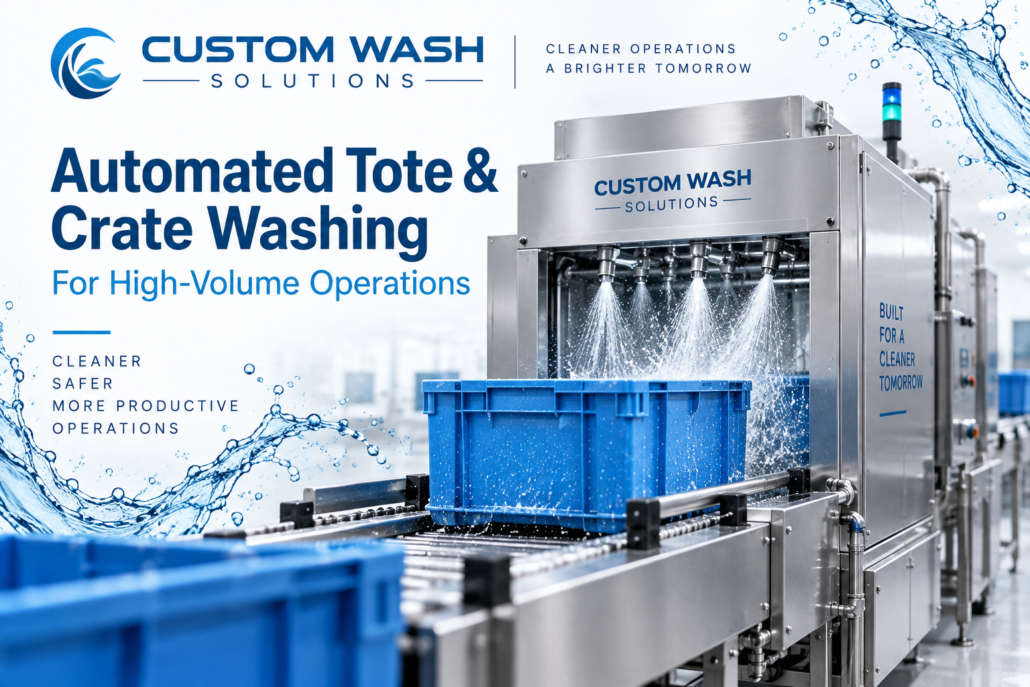
Custom Wash Solutions’ UN-Series systems use a pivoting spray system designed to thoroughly clean reusable totes and crates. Wash water is continuously filtered, and a separate rinse zone uses clean water before that water is reused in the washing process.
The goal is simple: create a more reliable and scalable sanitation process.
Reduce the Labor Required for Cleaning
Labor is another major reason companies begin looking at automated washing.
If employees spend hours manually cleaning crates, they are not available for other productive tasks.
Automation does not eliminate the need for employees. Instead, it allows employees to focus their time on activities where people provide greater value.
Rather than having workers scrub individual containers, an automated system can handle the repetitive washing process while employees manage production, quality, material handling, or other responsibilities.
Keep Containers Moving Through Production
Reusable containers only provide value when they are available for use.
If dirty totes and crates begin accumulating because cleaning cannot keep pace with production, the shortage can affect the entire operation.
High-capacity washing systems help shorten the time between a container being used, cleaned, and returned to service.
Depending on the application and selected configuration, the standard Custom Wash Solutions crate washer can process approximately 200 to 800 crates per hour.
For high-volume facilities, that level of throughput can help keep container availability aligned with production demand.
Water Efficiency Is Part of the Equation
Industrial washing requires water, but modern systems can be designed to use that water more intelligently.
The UN-Series continuously filters wash water. Clean water used during the rinse stage can then be reused during washing, helping reduce unnecessary water consumption while maintaining cleaning performance.
The standard configuration also allows water consumption to be adjusted based on the application.
For manufacturers looking closely at operating costs and sustainability goals, those efficiencies matter.
Not Every Facility Has the Same Cleaning Challenge
A bakery does not necessarily wash the same containers as a poultry processor.
A beverage operation may have different residues than an agricultural facility.
That is why industrial washing equipment should not be viewed as a one-size-fits-all purchase.
Factors such as container dimensions, contamination level, required throughput, available floor space, sanitation requirements, and production flow should all be considered when designing the washing process.
Custom Wash Solutions tote and crate washers can be customized around the requirements of an individual operation.
Is It Time to Automate Your Tote and Crate Washing?
If reusable containers are becoming a sanitation challenge or consuming too much employee time, it may be worth evaluating automation.
Some common signs include:
- Employees spending significant time manually washing containers
- Cleaning results varying from shift to shift
- Dirty containers accumulating faster than employees can clean them
- Production waiting for clean totes or crates
- Increasing concerns about water, labor, or sanitation costs
- Growth making the existing cleaning process difficult to scale
The objective is not simply to buy another piece of equipment.
It is to create a better process.
A properly designed tote and crate washing system can help a facility improve sanitation consistency, reduce repetitive manual work, control water usage, and return reusable containers to production faster.
Learn More About Tote and Crate Washing
Custom Wash Solutions provides industrial tote and crate washing systems for food processing, dairy, meat and protein processing, agriculture, beverage, retail distribution, and other demanding environments.
If your facility is spending too much time washing reusable containers—or your current cleaning process can no longer keep up with production—our team can help evaluate the application and determine the right washing solution.
Talk with Custom Wash Solutions about your tote and crate cleaning application.